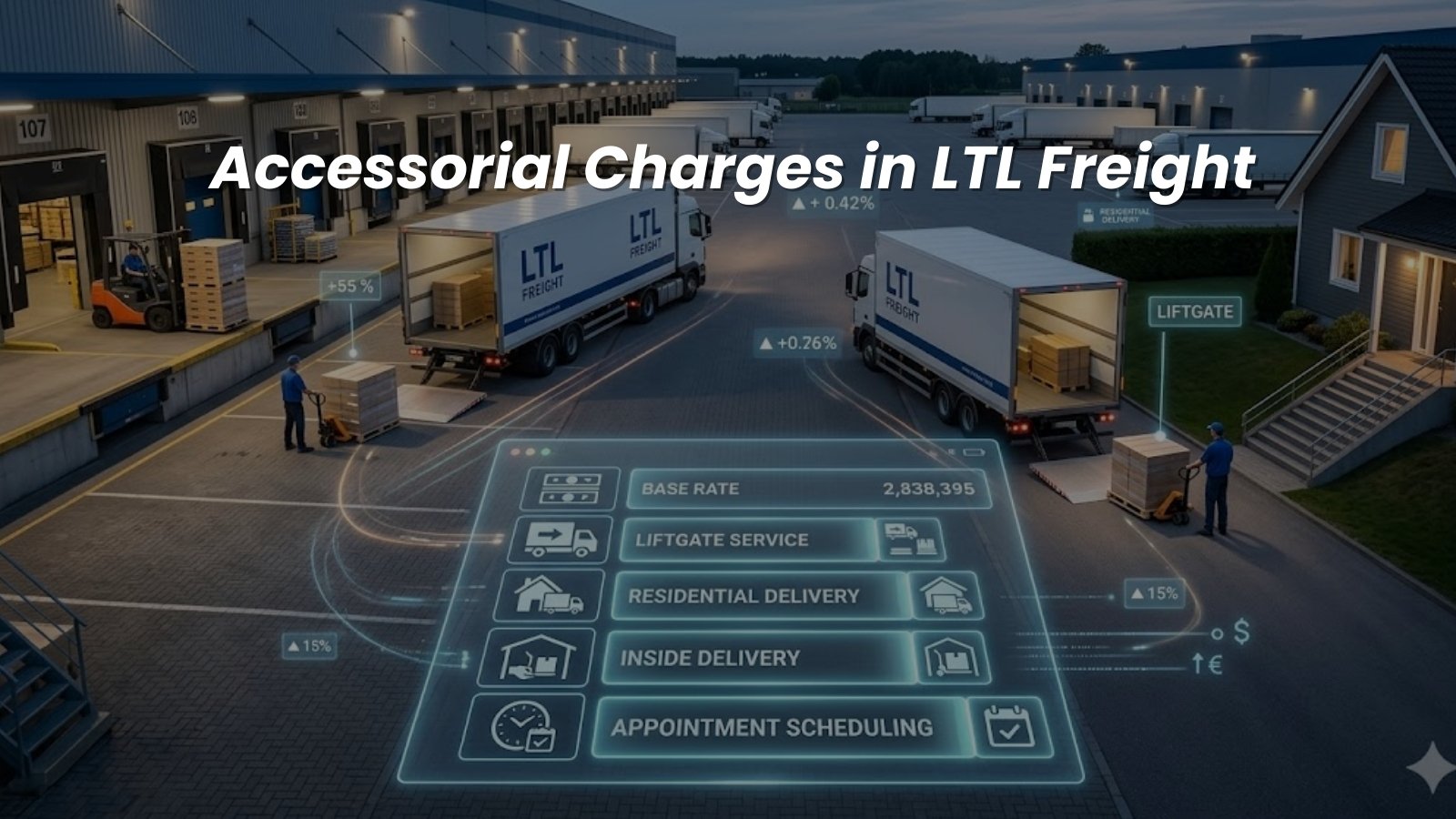
In Less Than Truckload (LTL) freight, the base rate covers transportation between standard commercial locations with loading docks and regular business hours. However, many shipments involve additional services beyond basic pickup and delivery. These extra services are known as accessorial charges.
Accessorial charges are common in LTL because shipments move through structured carrier networks with defined operational assumptions. When a shipment requires handling outside those standard conditions, additional fees apply to cover the added labor, time, or equipment.
One of the most frequent accessorial charges is liftgate service. If the pickup or delivery location does not have a loading dock or forklift, the carrier may need a truck equipped with a hydraulic liftgate to load or unload freight. This equipment requires extra time and handling, which results in an added charge.
Residential delivery is another common accessorial. LTL networks are designed primarily for commercial locations. Delivering to a residential address requires additional coordination and sometimes smaller vehicles, leading to extra fees.
Limited access locations, such as construction sites, schools, military bases, or remote facilities, may also incur charges. These locations often require special scheduling or security clearance, which increases operational complexity.
Reclassification fees occur when the declared freight class, weight, or dimensions do not match the actual shipment. If a carrier measures the freight and finds discrepancies, the shipment may be re-rated at a higher class, resulting in additional charges.
Inside delivery or inside pickup services involve moving freight beyond the standard curbside or dock location. When drivers must enter a building or position freight inside a facility, additional labor is required, and accessorial fees apply.
Appointment scheduling fees may also arise. If delivery requires a specific time window rather than standard business hours, carriers may charge for the coordination and wait time involved.
Understanding accessorial charges helps businesses budget more accurately. Many of these fees can be avoided through clear communication at the time of booking. Providing accurate information about location type, equipment availability, and shipment dimensions reduces unexpected billing adjustments.
LTL freight offers cost savings for smaller shipments, but awareness of potential accessorials ensures smoother operations and fewer surprises after delivery.
Frequently Asked Questions
What are accessorial charges in LTL freight?
They are additional fees for services beyond standard pickup and delivery.
Can accessorial charges be avoided?
Often yes, by providing accurate shipment and location details during booking.
What is a liftgate fee?
It is a charge for using a truck equipped with a hydraulic liftgate when no dock is available.
Why do residential deliveries cost more?
Because LTL networks are primarily designed for commercial locations.
What causes reclassification charges?
Incorrectly declared weight, dimensions, or freight class.