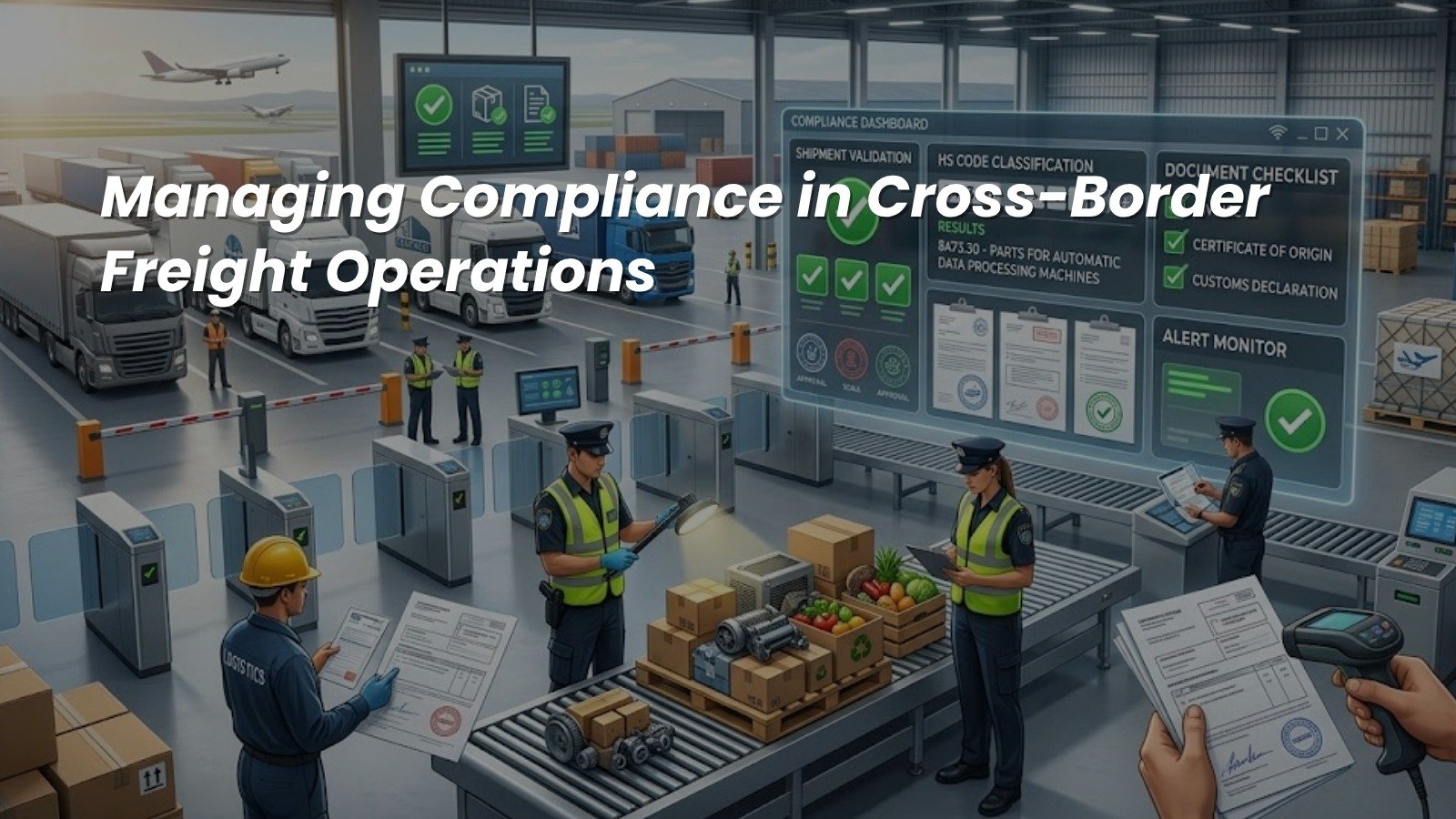
Cross-border freight does not fail because trucks break down or because borders exist.
It fails most often because compliance details are misunderstood, rushed, or treated as secondary to transportation planning. In reality, compliance is not a side process—it is central to whether freight moves smoothly or gets delayed, inspected, or penalized.
When goods move between countries by road, multimodal transport, or combined air and truck networks, they enter a regulatory environment that includes customs laws, trade agreements, product-specific controls, documentation rules, and enforcement procedures. Managing compliance properly means understanding that freight planning and regulatory planning must happen together.
This guide explains how compliance works in cross-border freight operations, what responsibilities fall on shippers, and how businesses can reduce delays, inspections, and unexpected charges through better preparation.
Understanding Compliance in Cross-Border Freight
Compliance in cross-border freight refers to meeting all regulatory, documentation, tax, safety, and classification requirements imposed by both the exporting and importing countries. It includes accurate paperwork, proper product classification, correct declaration of value, and adherence to any licensing or inspection rules that apply to specific goods.
Compliance is not only about avoiding penalties. It directly affects transit time, cost predictability, and customer relationships. A shipment that arrives at the border with incomplete paperwork or incorrect tariff codes may face inspection holds, reclassification fees, or additional duties.
Who Is Responsible for Compliance?
Many businesses assume that freight forwarders or customs brokers “handle compliance.” While brokers play a central role in filing documentation and communicating with authorities, the legal responsibility for accurate declarations generally rests with the importer or exporter of record.
The shipper must provide:
• Correct product descriptions
• Accurate declared value
• Proper HS (Harmonized System) codes
• Any required licenses or certificates
• Country-of-origin documentation
Failure in any of these areas can result in shipment holds, fines, or retroactive duty assessments.
HS Classification and Why It Matters
One of the most common compliance errors in cross-border freight involves incorrect HS classification. The HS code determines duty rate, eligibility for trade agreements, and whether additional inspections apply.
Misclassification can happen when businesses rely on outdated codes, copy classifications from similar products, or assume the same product qualifies under multiple trade agreements. Border authorities increasingly use automated systems to cross-check declared codes against product descriptions and historical data.
A careful review of classification before the shipment departs is far more effective than attempting to correct errors after the freight reaches the border.
Trade Agreements and Preferential Treatment
Many cross-border shipments move under regional trade agreements that reduce or eliminate duties. However, claiming preferential treatment requires proper documentation and eligibility verification.
To qualify, goods must meet rules of origin requirements, which may involve specific manufacturing thresholds or sourcing conditions. Simply shipping between two countries in a trade agreement zone does not automatically grant reduced duty rates.
Importers must ensure that certificates of origin are complete, accurate, and supported by manufacturing records when necessary. Incorrect claims can result in audits or backdated duty demands.
Documentation Flow in Cross-Border Freight
Cross-border compliance depends heavily on synchronized documentation. The key documents typically include:
• Commercial invoice
• Packing list
• Bill of lading or airway bill
• Customs declaration
• Certificate of origin (if applicable)
• Import/export licenses (when required)
Each document must align in terms of product description, quantities, weight, and declared value. Even small inconsistencies between the invoice and packing list can trigger manual review.
Digital Filing and Pre-Clearance
Many border authorities now require electronic pre-filing of shipment data before physical arrival at the border. This allows customs agencies to assess risk profiles in advance.
Pre-clearance can significantly reduce border waiting times when documentation is accurate and submitted early. However, incorrect digital filings may result in system rejections that delay trucks before they even reach inspection points.
Regulated and Restricted Goods
Certain product categories require additional compliance steps. These may include:
• Pharmaceuticals
• Food and agricultural products
• Chemicals
• Automotive components
• Electronics with controlled technology
Such goods may require health certificates, phytosanitary inspections, safety certifications, or special import permits. Failing to secure these in advance can result in shipment refusal or forced return to origin.
Inspections and Risk-Based Controls
Border inspections are not random in the traditional sense. Most countries use risk-based systems that analyze data such as importer history, product category, declared value anomalies, and compliance record.
Businesses that consistently file accurate documentation and respond promptly to queries are less likely to face repeated inspections. Maintaining a clean compliance history can reduce long-term border friction.
Penalties and Financial Exposure
Compliance failures can lead to several types of financial exposure:
• Administrative fines
• Additional duties and taxes
• Storage and demurrage charges
• Shipment re-export costs
• Loss of preferential trade status
In severe cases, authorities may suspend importer numbers or require additional security bonds for future shipments.
Building an Internal Compliance Process
Cross-border freight compliance works best when businesses create internal processes rather than relying on last-minute document preparation.
A structured approach typically includes:
• Centralized product classification database
• Standardized invoice templates
• Trade agreement eligibility checks
• Regular internal audits of HS codes
• Coordination between logistics and finance teams
By aligning operations and compliance departments, companies reduce the likelihood of documentation mismatches.
The Role of Customs Brokers
Customs brokers act as licensed intermediaries between shippers and government authorities. Their responsibilities include filing declarations, calculating duties, communicating inspection requirements, and advising on regulatory changes.
However, brokers rely on accurate information from shippers. A broker cannot correct incomplete product data after submission without risking amendment penalties.
Choosing a broker familiar with specific trade lanes and product categories can reduce errors and speed up clearance processes.
Technology and Compliance Management
Modern cross-border freight increasingly uses digital compliance tools. These systems may integrate classification databases, automated duty calculations, document management, and regulatory alerts.
Technology does not eliminate compliance risk, but it improves consistency and traceability. Digital systems also make it easier to respond to customs audits by maintaining organized documentation archives.
Planning for Audits
Customs audits may occur months or years after shipment clearance. Authorities may review classification accuracy, valuation methods, or trade agreement claims.
Businesses should retain all supporting documentation, including supplier invoices and origin declarations. Preparing for audits proactively reduces financial exposure and administrative stress.
Common Compliance Mistakes
Several recurring issues cause avoidable border delays:
• Incorrect or vague product descriptions
• Undervaluation of goods
• Mismatched weights or quantities
• Missing certificates of origin
• Expired licenses
• Incorrect importer identification numbers
Most of these issues arise from rushed documentation or lack of standardized internal processes.
Balancing Speed and Accuracy
Cross-border freight often operates under tight delivery schedules. However, accelerating shipment departure without verifying compliance can create greater delays later.
A shipment delayed for documentation correction at the border may lose more time than one delayed briefly at origin for review. In cross-border operations, accuracy frequently protects overall speed.
Frequently Asked Questions
What is cross-border freight compliance?
It refers to meeting all customs, tax, documentation, and regulatory requirements when shipping goods between countries.
Who is legally responsible for customs compliance?
Typically, the importer or exporter of record holds legal responsibility for accurate declarations, even if a broker files paperwork.
How can businesses reduce border delays?
By verifying documentation accuracy, using correct HS codes, submitting digital filings early, and maintaining strong communication with brokers.
Are inspections random?
Most inspections are risk-based, relying on historical compliance data and shipment profiles.
What happens if HS codes are incorrect?
Authorities may reclassify goods, impose additional duties, or levy fines.
How long should compliance documents be stored?
Retention periods vary by country, but many authorities require records to be maintained for several years after clearance.